Plus
Plus

 Menu
Menu


Artemii Lebedev
SerbiaJuly 08, 2026
Mindsparkle Mag


Artemii Lebedev works across websites, brand experience, 3D, and music visuals, moving between design and something closer to visual art. Through Le:mma.Studio, he builds digital projects for agencies, startups, and independent brands, while his visuals for the electronic act Goom Gum translate that same sensibility onto festival stages and giant screens.
Twice named Designer of the Year, and a juror who has reviewed thousands of websites, Lebedev has built a reputation for work with a distinctly cinematic feel — rhythm, tension, and a sense of anticipation borrowed as much from film and music as from interface design.
We spoke with Artemii about the muscle of creativity, the difference between designing for a screen and for a room, and why an idea still matters more than a beautifully executed effect.
✜ Hey Artemii, happy to have you. What are you currently working on?
→ Hi, happy to be here.
Quite recently, I updated my portfolio, completely rethinking the visual language and going through all the cases again. I think every designer has that moment when you realize you’ve somehow outgrown your previous portfolio, and internally everything starts asking for change.
At the same time, I’m working on several projects. The closest one to launch is a student housing project near USC. The style is not entirely typical for me, which makes it even more interesting, both visually and conceptually. The student audience today is very different from ten years ago, and it feels exciting to create something for a new generation.
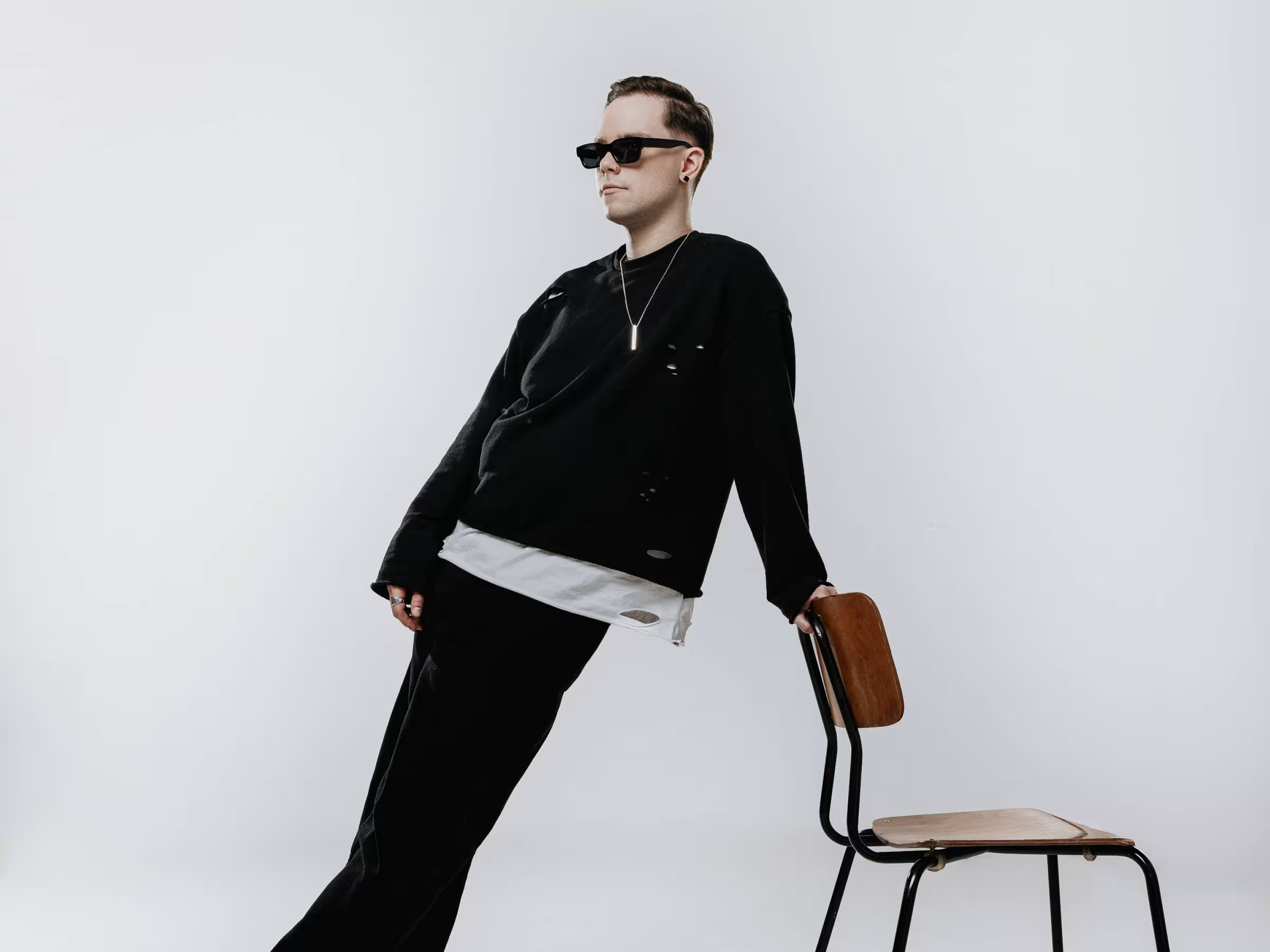
✜ When people ask what you do, what’s the honest answer now? Designer, art director, visual artist, studio founder — or something in between?
→ A few years ago, I would have simply said “designer,” but now that feels a little too narrow. I still design interfaces and visual systems, but my work has become more about direction, meaning, atmosphere, and how a project feels as a whole.
With the rise of AI, the role of a designer is changing very quickly. In some ways, many independent designers are becoming creative generalists. The tools are expanding, and approaches that once required large teams are becoming more accessible to individuals.
But I don’t think the essence of the work has changed that much. You can call it design, art direction, creative direction, or something in between. For me, the core is still the same: helping a business translate what it does into something people can understand, feel, and connect with.
I also like to separate my practice into two parts. In my main work, including Le:mma.Studio, I’m still a designer. That’s the foundation. But when I work with musicians or create personal experiments, I feel much closer to being a visual artist. So the honest answer is probably somewhere between those two worlds.
✜ Your work moves across websites, brand experiences, 3D, music visuals and personal experiments. Was that always the plan, or did the practice slowly grow in that direction?
→ There was never a very deliberate plan behind my career. Most of it grew from curiosity, and curiosity is still the main reason behind many of my experiments today.
My first real focus was mobile interfaces. At that time, mobile felt like new territory: augmented reality, virtual try-ons, face scanning, and many other things were just beginning to appear. The transition into web happened almost by accident, when a client wanted to launch a website for his mobile app and didn’t mind that web design was still new territory for me.
Around the same time, I heard a phrase that stayed with me: creativity is like a muscle. Like athletes, you have to keep training. Only through constant practice do you grow.
That mindset led to many personal concepts on Instagram. Some were quick ten-minute experiments, while others took seven evenings or more, especially when 3D was involved. The questions were simple: “How did they make that transition in this film?” or “Why do the scene changes in this music video feel so good?”
Over time, all those separate experiments became part of the same practice. Websites, 3D, visual systems, music visuals, and idea generation didn’t come from one big plan. They grew naturally from curiosity, repetition, and the desire to keep trying new things.
✜ A lot of your digital work has this cinematic feeling, almost like the beginning of a film or a music video. Where do you think that comes from?
→ It’s really nice that you noticed that.
I think it comes from being a huge fan of music, films, and especially TV series. I still remember my first impression of See. The light, the camera work, the editing, the atmosphere — everything worked together in a way that made it impossible to look away.
I’ve always wanted to bring a little of that feeling into the way projects are presented. Not in a literal cinematic way, because in our field the main character is not an actor, but the project itself.
Sometimes you have video material, interviews, process footage, or a more artistic industry, and the cinematic feeling appears more naturally. Other times, especially with functional or B2B projects, the challenge is to create atmosphere with fewer tools.
For me, cinematic does not always mean film-like visuals. It can be rhythm, pacing, transitions, light, contrast, silence, tension, or simply the feeling that something is about to begin. I think that’s what I’m usually chasing: a small sense of anticipation that makes the viewer want to stay inside the project a little longer.

✜ With Le:mma Studio, what are you trying to protect or keep alive in digital design that you feel is often missing online today?
→ I think web design today can be divided into a few different worlds.
There are specialists working on complex internal products, where a lot of the work remains almost invisible from the outside. Then there is a huge layer of designers building startup websites at a very fast pace, where speed and business needs are the main focus.
And then there is the space where Le:mma Studio and I belong: agencies, studios, and independent designers trying to build projects a little deeper than just the business frame. Here, speed is not always the most important value. Thinking is. Emotion, rhythm, visual decisions, and the overall feeling all work together to create a connection between a business and its audience.
That is probably what I’m trying to protect: the idea that a digital project can still be more than a page with information. It can be an experience. It can have character, atmosphere, authorship, and a point of view, while still serving the business and its goals.
Especially now, with the rise of AI, unique and unexpected ideas are becoming more valuable than just a set of beautiful images. The idea comes first. And if that idea can grow across different formats and points of view, then the project really starts to live.
✜ You also create visuals for Goom Gum, where the work is connected to music, atmosphere and live energy. What changes when the design is not just viewed on a screen, but felt in a room?
→ At the beginning, I didn’t fully understand the difference, because I had never seen the work in the context of a live show. The first tasks were mostly visual images for track releases on platforms like Spotify, Apple Music, and Beatport, with animated versions for social media.
As the collaboration with Goom Gum grew, we decided to create a visual pack for their live performances. At first, the shows were mostly across Europe, and later they expanded around the world, including the US and Asia. It was exciting, but also a little scary, because you don’t want the work to feel wrong when it becomes part of a real show.
After testing the first pack, the difference became very clear. A giant screen is not the same as a phone or a laptop. It has to create depth. The motion doesn’t always need to be fast or aggressive. What matters more is building a third space inside that flat screen — a feeling that you can almost fall into it, or that something is moving toward you.
That is what changes when the work is felt in a room. It becomes less about details and more about presence, scale, rhythm, light, and energy. The audience reacts not only to the image itself, but to the way it works with the music, the lighting, and the atmosphere.
When the visuals, music, and lights start to breathe together, the work stops being just an image on a screen and becomes part of the experience.
✜ When you start a new project, what usually hits first: a mood, a story, a technical idea, a visual reference, or just a strange feeling you want to follow?
→ It really depends on the project and the industry. Some fields are easier to understand from the beginning. You quickly feel what the project needs, where the story is, and what kind of visual language could work. With other industries, it takes much longer. Sometimes you have to return to the first step five, ten, or even fifteen times before finding that one obvious thread hidden a little deeper.
Often, it starts with searching for that thread — something that connects the business, the audience, the industry, and the feeling of the project. A deep immersion into the field helps a lot.
Collaboration also plays a big role. I try not to simply transfer the client’s thoughts, or my own thoughts, onto a digital canvas. The best projects usually happen when both sides are involved in the search.
I’ve also noticed that some projects almost need to be reborn halfway through. Sometimes everything is technically moving forward, but internally something feels wrong. At that point, the best decision is to stop, return to the beginning, and look at the whole concept again from zero. That happened with Monolith Studio and Hungry Tiger, and in the end, both became some of the strongest works for me.
So maybe the first thing is not a reference or a mood, but a strange feeling that there is something deeper to find. The whole process is about staying patient enough to find it.
✜ Your work often feels polished and high-end, but there’s also tension, darkness and drama in it. Is that mood something you consciously build, or is it simply part of your taste?
→ I think it is partly my taste, but not something I try to force into every project. Design is still client work, so the mood has to come from the project itself: the brand, the audience, the story, the industry, and the feeling we are trying to create. Something dark or dramatic only works when it belongs there.
At the same time, a designer can never fully disappear from the work. Taste always finds its way in through contrast, silence, shadows, rhythm, and the amount of tension in the composition. I’ve always been drawn to visuals that feel a little dramatic or cinematic — not necessarily dark, but with some kind of pressure inside them.
Music probably has a lot to do with it as well. My personal art practice has also influenced this. In 2023, I released Humanity, a collection of 3D portraits and animations, each exploring a human emotion we often try to hide from others. Looking back, that project feels like a turning point in my visual style.
So I would say it is both conscious and unconscious. I can build that mood intentionally when the project needs it, but the reason I notice and choose those moments probably comes from taste, music, art, and personal experience.

✜ You’ve judged, won and probably seen hundreds of digital projects by now. What still makes a website feel fresh to you?
→ You made me curious about how many projects I have reviewed as a jury member over the years. Unfortunately, after a system update, that number is no longer available, but I think it is already several thousand websites — maybe even around eight or nine thousand by now.
Earlier in my career, I was much more impressed by motion, transitions, and technical execution. At that time, many of those things felt new, especially with 3D, WebGL, and the idea of creating entire worlds inside websites.
That can still be impressive today. But now, the first thing I pay attention to is the idea behind the project. A beautifully executed website without a strong idea rarely stays with me. The same goes for trendy effects. They can be well made, but if they only exist on the surface, they usually don’t feel fresh.
What feels fresh to me is when a project finds a strong core: an element, a symbol, a visual language, or a behavior that can transform depending on the context while still defining the whole tone of the experience. For me, freshness is not just about doing something new. It is about finding an idea strong enough to hold the whole experience together.
✜ Awards are a strange thing. They can open doors, but they can also create pressure. After winning Designer of the Year twice, did your relationship with the work change?
→ It’s funny, because not so long ago I discussed this with my fiancée. Does it create pressure? Am I afraid that people expect something new, stronger, or better than before?
In the beginning, yes. There was a feeling that I had to somehow surpass my previous projects. The fear of making something weaker was definitely there. But I think this is mostly psychological. I had to live with those thoughts for a while and slowly rethink them.
At some point, the main question becomes: am I doing this for the expectations of the audience, or because I still enjoy the process myself? The answer usually finds itself. You return to your own dreams, goals, curiosity, and philosophy.
I think I was lucky to win Designer of the Year twice at a more mature age, at 28 and 29. I’m not sure I would have handled it the same way at 22. Awards are a beautiful confirmation that your work is seen and valued, but they should not become the reason you create. The most important thing is still to love what you do, follow your own interests, and not look back too much.

✜ What is one thing in the current digital design scene that genuinely excites you, and one thing that quietly gets on your nerves?
→ I’m not one of those people who believe that AI has made everything “artificial”. Actually, what excites me is the opposite. I like the idea that designers can now move faster and bring to life ideas that were previously blocked by a lack of technical knowledge.
We can create small tools for ourselves, calculators, modifiers, prototypes, and systems that help push projects further. In a way, many designers are becoming closer to engineers and builders, not just people who create visuals. In the right hands, this is an endless source of possibilities.
What quietly gets on my nerves is the amount of copying. Some people simply prompt other people’s work, slightly change the result, present it as their own, and seem completely fine with it. That is surprising and disappointing.
Maybe the industry will eventually need new ways to protect digital work. But the problem is definitely there. Not AI itself, but the scale of copying and the lack of responsibility around it.
✜ If we walked into your studio during the messy middle of a project, what would we actually see — calm structure, chaos, 200 tabs open, loud music, or something else?
→ Calm structure is probably not the first thing you would see. There would definitely be a Spotify playlist playing in the background, usually something fast, mostly techno or melodic techno with metallic textures. There would be a cup of black coffee, no sugar, no milk. The lights would be dimmed, because I feel much more comfortable working that way than in a fully lit room.
Most of my productive work happens in the evening. I’m probably more of a night person, so the room usually feels more active later in the day. At some point, when I get into the flow, I almost stop hearing the music, but it still helps me keep the pace I need, especially during the concept stage.
On the screen, it would probably look like a mess: unnamed layers, random groups, broken frames, old directions pushed to the side, new ones appearing on top, and 30 to 50 browser tabs full of references, moods, images, scenes, and visual fragments from completely different worlds.
But it is not chaos in a destructive sense. It is more like a working chaos. The beginning of a project needs that freedom, because you are still searching for the direction. Later, once the idea becomes clearer, everything slowly turns into structure and starts to feel like a system.
For someone else, it probably looks chaotic. For me, it feels familiar, comfortable, and strangely productive.
✜ Last one: if your work had to be played as a DJ set, what would the opening track feel like?
→ I would probably mention Massano’s Shut Down or PACS’ Timeshift (2025 Remaster). For me, that kind of sound describes very well what I love and what I would start a set with.
It has a smooth but unexpected beginning, a constant sense of build-up, and those moments where the energy suddenly drops down and then rises sharply again, creating pressure. That combination of tension, depth, pressure, and controlled release feels very close to the way I like to build visual work as well.
Thanks for having me. It was a pleasure to reflect on all of this.
More of Artemii Lebedev's work can be found at artemiilebedev.com. Make sure to follow Artemii on Instagram or connect via Linkedin.
Credits: Artemii Lebedev
More in Interview
Stay on top of this week's design. Insights, top picks & more.