Plus
Plus

 Menu
Menu


Maria Vareva
United StatesJanuary 31, 2026
Mindsparkle Mag


Maria Vareva designs AI tools that quietly change how humans and software work together. Not by adding more layers, features, or spectacle — but by removing friction, redundancy, and uncertainty where it matters most.
Currently a Lead Product Designer at Hints, Maria has worked across fintech, cybersecurity, consumer finance, and research-driven product environments. From building products from zero to shaping complex systems where trust is fragile and mistakes are costly, her work consistently returns to one core idea: turning complexity into clarity.
Awarded by CSSDA, Awwwards, Webby Awards, and the Apple Design Awards, Maria’s approach blends sharp product thinking with restraint, craft, and a strong sense of responsibility — especially in the age of AI.
We spoke with Maria about designing AI workflows, recognizing strong ideas early, and what “done” really means in product design.
✜ You describe your work as designing AI tools that reshape human–software interaction. What does that actually mean to you, beyond the headline?
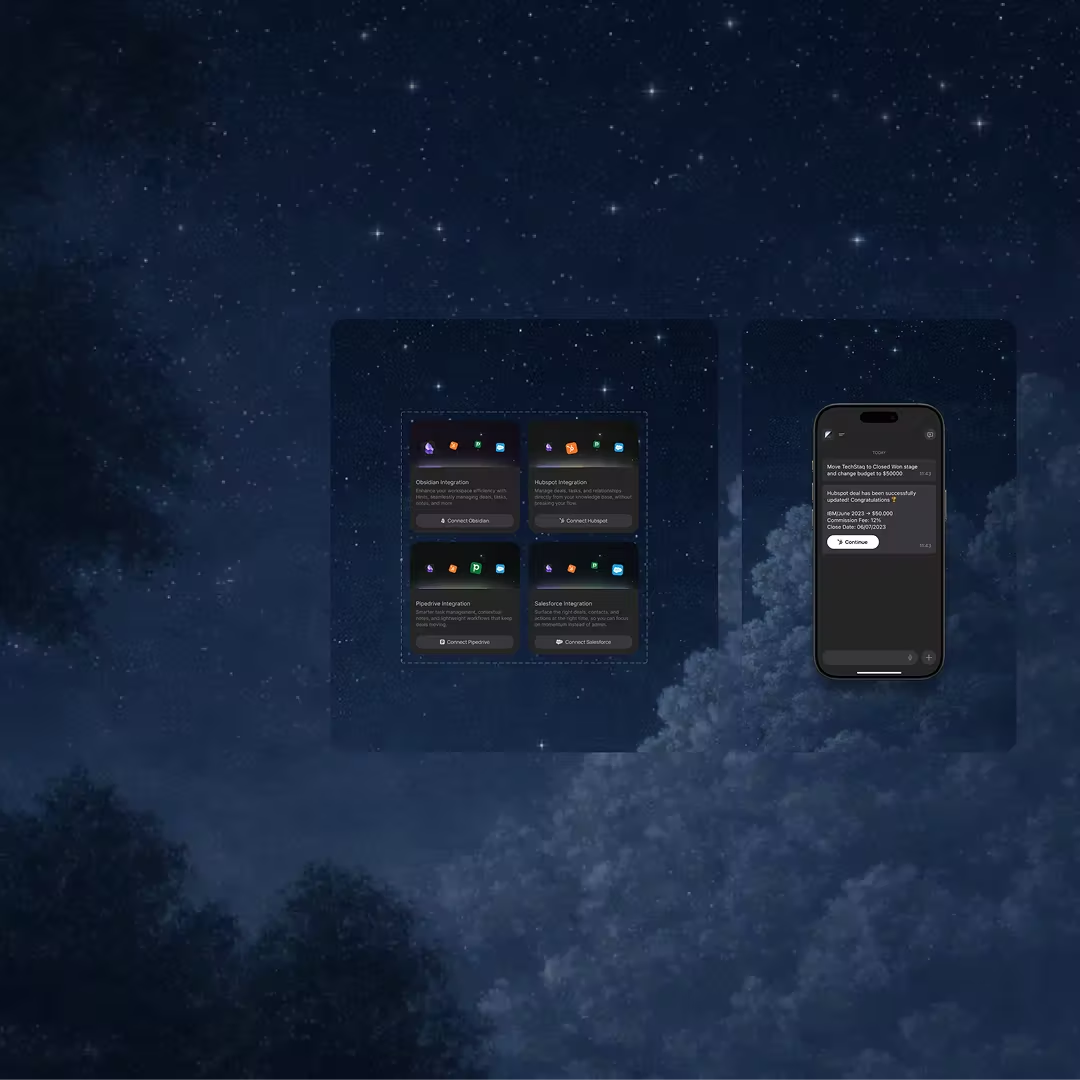
→ To me, “reshaping human–software interaction” is about redefining how — and when — people engage with an interface. In my recent work, I place AI automation exactly where it removes the most redundant steps. When done well, software stops feeling like a maze of screens and starts acting as a fast, reliable workflow engine.
✜ Looking at your path — from fintech and cybersecurity to consumer finance, Cornell Tech, and now AI — what through-line do you see in your work?
→ Across fintech, cybersecurity, and AI — whether in sales, growth, or distribution — users often operate in moments where being wrong has real consequences and trust is fragile. I keep returning to the same core task: turning complexity, risk, and ambiguity into workflows that are clear, simple, and measurably effective.
My role is to deliver a smooth experience at its core, by design, without skipping the hard parts. That mindset applies across industries.
✜ You’ve worked both independently and inside fast-moving product teams. What did working solo teach you that still shapes how you lead design today?
→ Working solo taught me ruthless end-to-end ownership. When you design alone, the stakes are high — and they’re yours. You do the research, frame the problem, define success, choose tradeoffs, make the calls, ship, and test, often without a safety net.
It forces precision. You learn to focus on what’s truly high-leverage for users and the business, and to separate what’s important from what’s simply loud. That still shapes how I lead today: I default to clarity, grounded decisions tied to real goals, and choices that respect engineering and execution.
✜ You believe in strong ideas over strong opinions. How do you recognize a strong idea early, especially in rooms full of confident voices?
→ A strong idea shows clear contact with reality. It defines a real job to be done, outlines a path to the goal, and acknowledges the constraints it must respect — and it stays coherent under pressure.
In rooms full of strong voices, I try to simplify things. I narrow discussions down to three questions everyone should ask: What would make this work? What would make this wrong? And how do we find out quickly?
✜ Many designers equate craft with visual polish. How do you define craft in product design today?
→ For me, craft is the quality of product thinking made tangible — and, in the best cases, joyful.
✜ You’ve led design from 0→1 and also evolved existing products. Which phase do you find harder — and why?
0→1 is harder for me. You’re dealing with ambiguity from every direction: the problem is still forming, data is incomplete, constraints shift, and there’s no shared source of truth yet.
Existing products can be complex too, but focused, surgical improvements — when done well — can unlock outsized gains without the same level of uncertainty.
✜ Designing AI products raises new questions around trust, control, and responsibility. How has AI changed how you see your role as a designer?
→ AI forced me to treat trust as a core interaction primitive. Because AI is probabilistic, the experience must clearly communicate what the system knows, what it inferred, and where it’s uncertain.
I design for controlled autonomy: the system can propose and draft, but users verify, edit, and approve with minimal effort. My responsibility expanded from usability to accountability — because helpful but wrong isn’t really acceptable.
✜ Finally, when does a design feel finished to you — if it ever does?
→ I treat “done” as reaching a clear quality threshold, paired with a defined next learning loop.
Maria Vareva’s work reminds us that designing for AI isn’t about adding intelligence everywhere — it’s about knowing where not to. Her focus on clarity, responsibility, and reduction feels especially relevant as products grow more powerful and less predictable.
In a landscape full of strong opinions, her commitment to strong ideas — tested, grounded, and respectful of reality — stands out as both rare and necessary.
Creator: Maria Vareva







.avif)