

 Plus
Plus

 Menu
Menu


Que Calido Studio
August 25, 2026
Mindsparkle Mag


Que Cálido is part branding studio, part cultural antenna, part beautiful mess. Led by Keki Keselman in Buenos Aires, Que Cálido speaks in a language of food, humour, emotion, strategy, music and provocation — always circling back to one belief: brands are not built for audiences, users or markets first. They are built for people.
In a creative world increasingly shaped by speed, trends and artificial sameness, Keselman is interested in something slower and stranger: observation. Noticing the best architecture in a beehive, the best colours in flowers, and the best drama between animals. For him, creativity is not about producing more. It is about feeling more.
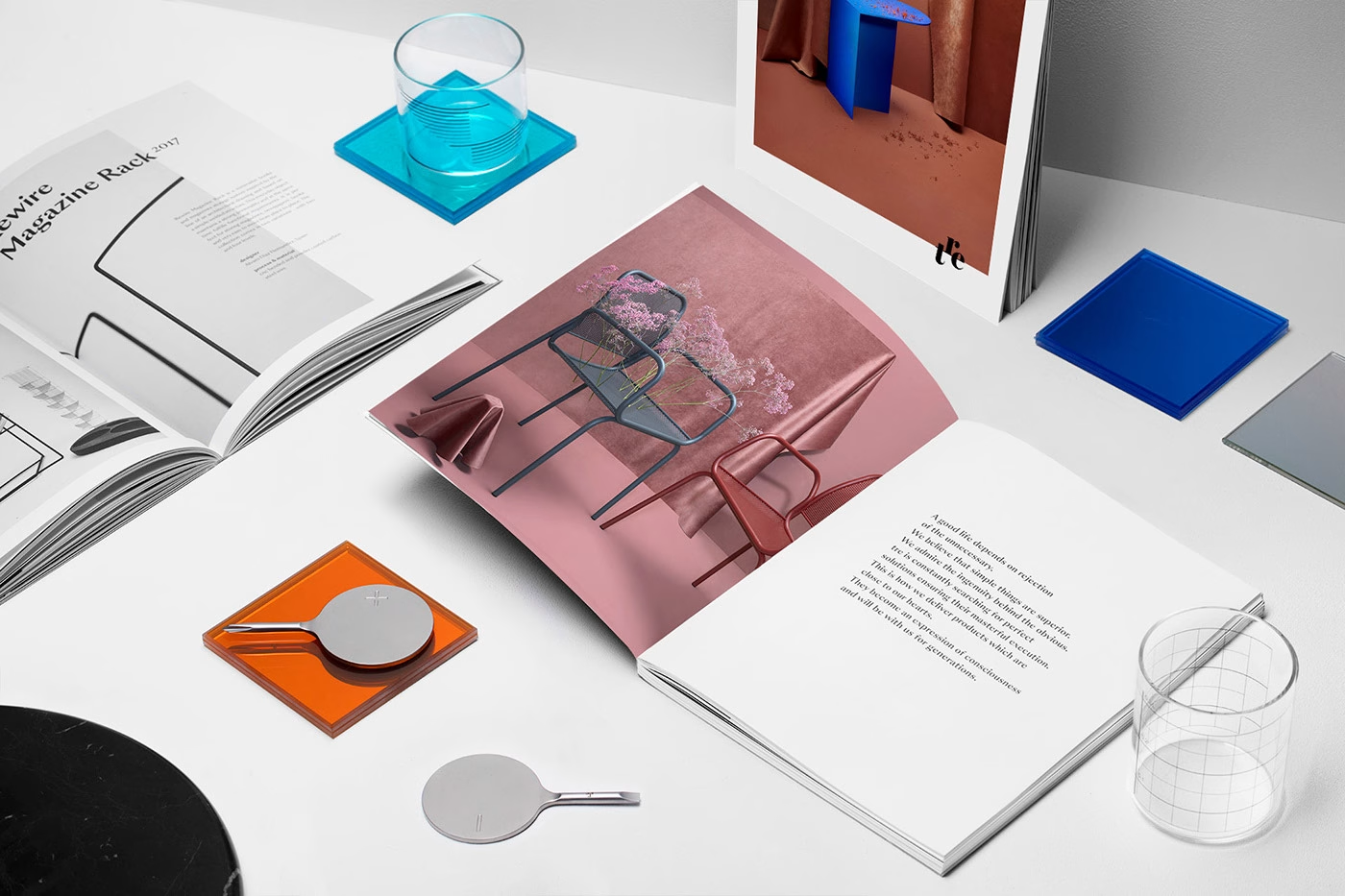
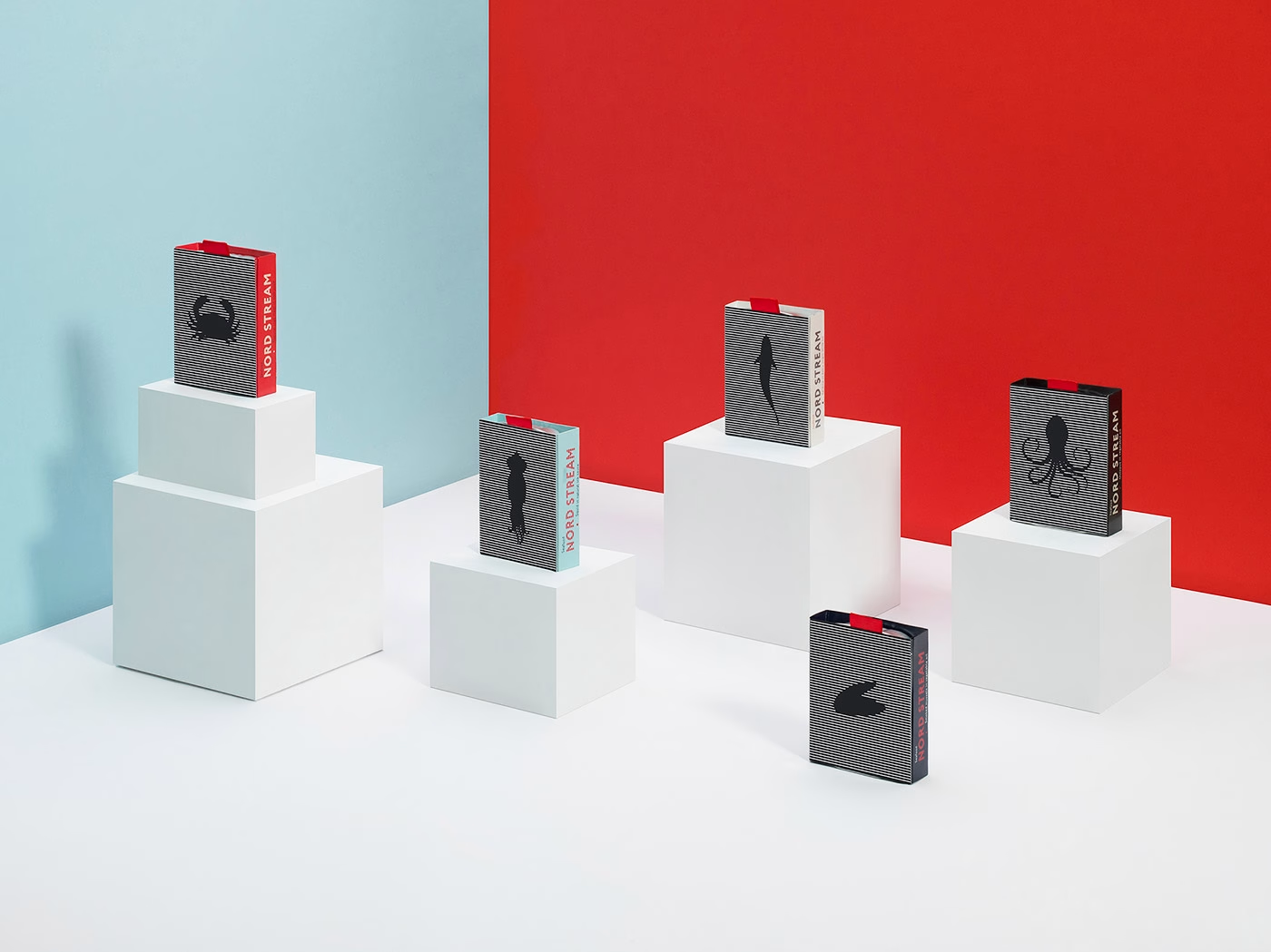
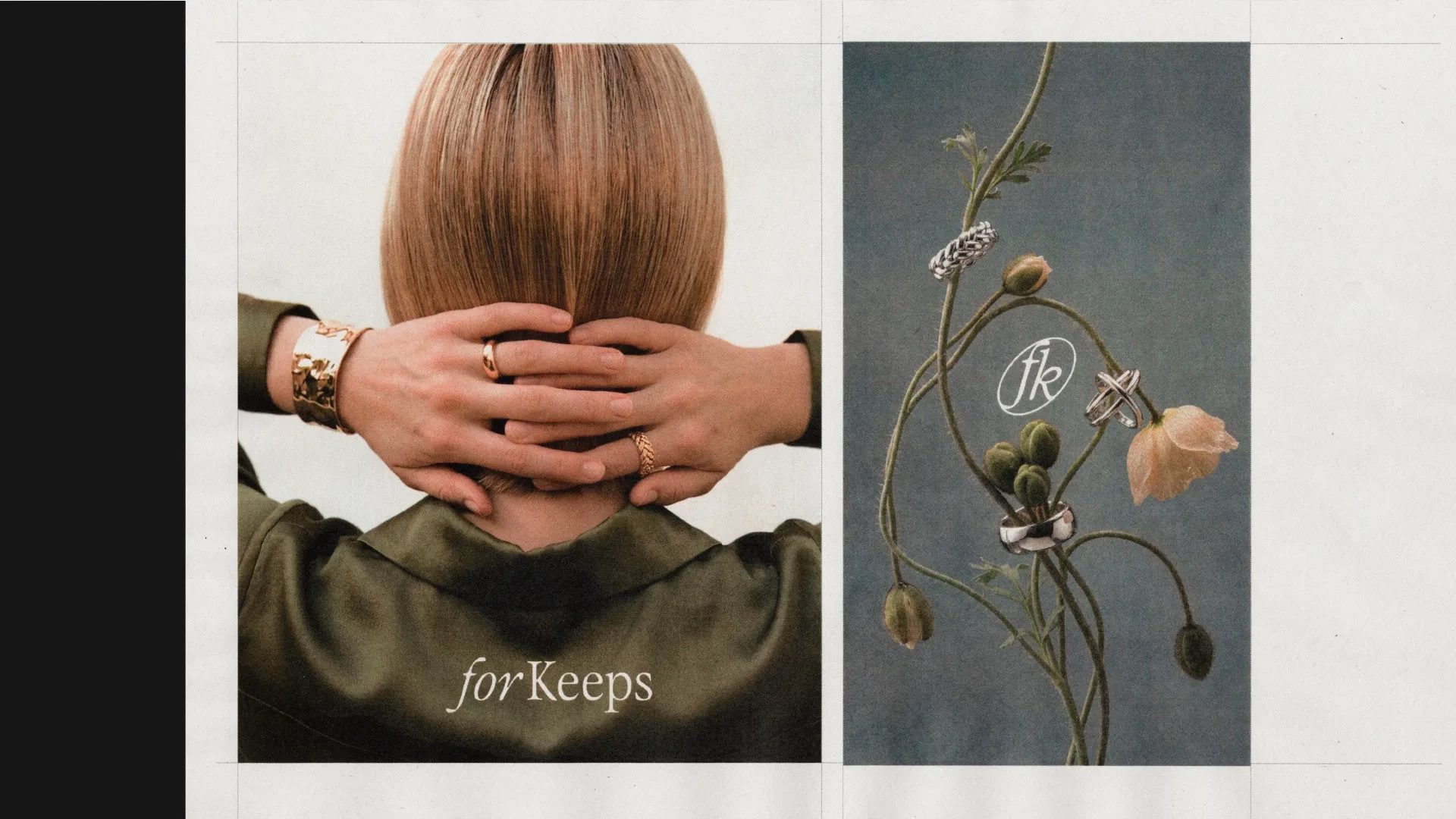
The studio has built visual identities across food, music, healthcare, finance and culture, from Chimichurri to the People's hand-painted approach to a mattress brand that refused to talk about sleep.
We spoke with Keki about copy-waste culture, human branding, Buenos Aires, intuition, AI, chimichurri, and why play is not the opposite of serious work — it is serious work.
✜ Hey Keki, happy to have you. You’re not just showing finished work online — you’re also talking, questioning, joking and sharing your way of seeing things. Did building a public voice become part of the studio almost naturally?
→ For me, everything eventually comes together naturally. Today, speaking to society and trying to show people, from whatever place each of us occupies, just how artificial we are becoming feels like an essential mission.
Questioning the world is as natural to me as breathing. I’m not satisfied with simply accepting what is already there. I believe there is so much more beyond the comfort of doing what we are told. What I want to spark in others is the question itself, because on the other side of a question, freedom appears.
Sharing finished work today means showing only one part of the story, and we’ve grown tired of revealing just the tip of the iceberg. It feels selfish. Creative work is not only about the outcome; it is far more complex than that. Otherwise, it becomes like a painting hanging in a museum; how deeply does it really move us?
The journey is the richest part of the process, because that’s where the greatest intensity lives. So we decided to let go of perfectionism a little and open the studio right down the middle, like a Barbie house, allowing people to see what we carry inside, and who we truly are.

✜ For people discovering Que Cálido for the first time, how would you explain what you do without using the usual branding studio words?
→ I love not using the usual branding terms, even though there’s an industry that often pushes you to define yourself in a very linear, easily digestible way. It’s hard to understand something different when everything today is so literal, so explicit. That’s how we end up having to be so clear that we all start sounding the same.
For me, that tension is a challenge I face every day. But the key is finding the balance.
If I had to bring it down to something more practical, we create. We bring new things into the world. We help materialize the dreams of people who take the risk of building businesses and turning their ideas into something real.
That might mean shaping someone’s entire experience inside a restaurant, or thinking about how people interact with a new product: its packaging, materials, colors, and textures. What do we feel when we walk into a bank? Or a hospital? How should design behave today to make people feel better?
Those experiences, interactions and feelings are what we create.
Anyway, I’ll take this opportunity to say what I really feel:
✜ Que Cálido talks about “People, Love & Creation.” It sounds simple, but also pretty rebellious today. What does that actually mean when you’re in the middle of a real client project?
→ It’s incredible that talking about people, love and creation feels rebellious today. It is, but that also says a lot about where we are.
To me, the creative process is a triangular dialogue between Spirit, Idea and Matter; Being, Thinking and Doing. We tend to understand creation as the act of materializing something, or maybe also the idea behind it. But I’d invite us to understand creation as something that goes beyond that mental and practical exercise. Our spirituality, and the level of connection we have with what we do, is a fundamental part of it.
In a way, People, Love & Creation is our attempt to express that. It’s Que Cálido’s triangle. It’s about bringing certain values of creativity back to the table, values the industry may be treating as obsolete, even though they are anything but.
In a real project, a client comes into Que Cálido and sometimes struggles to understand that we’re simply a group of people working together in a shared space, creating without a video call in between. But through the interaction, the dialogue, the listening and the dedication we bring to each project, there’s a lot of love and commitment. We leave a lot of ourselves in everything we do.
And creation itself is a very broad concept. The ability to create is a privilege we have as human beings. It speaks to something universal: the cosmos, creating life, nature. It goes far beyond creativity as we usually understand it.


✜ You often speak against this “copy-waste” culture. What do you think the creative world is copying too much right now?
→ Absolutely everything. The way we consume has changed dramatically. It has become a model built around convenience, not only physical convenience, but mental convenience too: “The less we have to think, the better.”
That’s what everything has become: flat, disposable. The trendy burger is the same everywhere. Specialty coffee looks the same all over the world. Everything becomes a techno party, a protein bar.
And today, the creative world responds to that same model. We design pieces for stories, make music to generate clicks, build buildings to sell shoeboxes, write for newsletters, and so on.
That’s why at Que Cálido Studio we put so much effort into creating things that feel unique, things that feel different at every point of interaction. When we create a new brand for a restaurant, we don’t approach it as if we were designing just another restaurant. We approach it as if the future of humanity depended on that experience.
It sounds dramatic, of course, but that level of commitment matters to us. Today, creating disruptive work with commitment and professionalism has become part of our mission.
✜ A lot of studios say they start with strategy. You seem to start with observation. What are you usually watching for before anything becomes visual?
→ Strategy is just a word. On its own, it doesn’t really answer anything. There’s no manual that tells you what a strategy is supposed to look like. We could even say that observation is our strategy.
But let’s put the word “strategy” aside for a second and get to what really matters. Observation is everything. Paying attention to what’s happening around us, being fully alert — that kind of attention is becoming an endangered state.
I’m not sure I can speak for the whole studio, because every person has their own way of searching and finding inspiration. But for me, the richest things are in nature: the best architecture is in a beehive, the best colors are in flowers, and the best dramatic scenes happen between animals.
That state of observation, always with a notebook in hand, gives me the tools I need when I eventually sit down to work on a project.
✜ Your work has a lot of appetite — visually, emotionally, culturally. Do you think that comes from Buenos Aires, from food culture, from music, from people, or just from your own taste?
→ There’s a bit of everything in there. Latin America has an incredible cultural diversity, in food, art, design, and also in its biodiversity.
Buenos Aires is a very eclectic city. It constantly pushes you to shift and change, and that’s always good for creativity. Food culture has also been booming for years now, and as a society it has taught us to give food a different place in our lives. It has become a form of personal expression, much like clothing or tattoos.
And music, for me, is always emotional. Both listening to music and making it can be a kind of mystical journey that very few artistic disciplines can offer in the same way.
And finally, yes: we’re a studio with very good taste. Ha!


✜ Que Cálido has worked across food, music, healthcare, finance and culture-driven brands. What changes when the subject is very serious, but you still want people to feel something?
→ Nothing changes — and that’s exactly what makes us realize that it isn’t something “out there”; it’s within us.
An artist who wants to design an album cover, an experimental chef, or the commercial director of a bank are all people, and every person feels. What happens is that job titles, stereotypes and even our own prejudices make us place people or brands into certain categories based on how they present themselves. But it doesn’t really work that way. That’s something we challenge ourselves to remember all the time.
The general manager of a large company has also felt the love of having children, gets transported by music, or is moved by a hug. And that same principle can be applied to the consumer, the client or the viewer: they are people who feel things.
In design and graphic art, those feelings often live in subtle details. That subtlety is where we work. Our mission is to create for all of them: People, Love & Creation.
✜ With a project like Chimichurri to the People, there’s this feeling of taking something everyday and making it iconic. How do you know when a simple idea has enough power to become a brand?
→ You just know. I don’t know how, but you do. It never stops being a game, and that’s what makes it exciting.
One day you say, “CHIMICHURRI TO THE PEOPLE,” we need to bring chimichurri to the whole world. The next day, you dream of a yellow can sitting in every kitchen around the globe. You wake up, draw it, and then get to work on bringing it into the real world.
What is a good brand, if not that? A game, a dream, and a few crazy people willing to make it happen.

✜ You talk a lot about sensitivity. In practice, what does a sensitive designer notice that another designer might miss?
→ I don’t think there is such a thing as a sensitive designer and an insensitive one. I think we’re all sensitive, it’s just easier for some people to break through that wall.
I also think it has to do with skepticism. To be sensitive, and to actually use that sensitivity, you have to believe. Believe in what? In those signals you see all the time but often choose to ignore out of fear.
Once you’ve learned to embrace and trust that sensitivity, creating becomes magical, and everything starts to take on an incredible sense of meaning. You stop working for the system and start doing it for yourself. It becomes something vital.
Sensitivity, mysticism and spirituality give us the ability to perceive energies, to feel what resonates, and to understand the universe as something interconnected. In the end, we become channels for energy, transforming it into matter.
✜ Intuition sounds beautiful, but clients also need clarity, structure and business results. How do you make gut feeling useful in the room?
→ One of my favorite quotes is: “The crazy one is not the one who has crazy ideas, but the one who is sane enough to bring them to life.”
Madness, chaos and intuitive creation are not enemies of clarity, structure or results. We tend to see them as opposite forces, but they’re not. Otherwise, they would just remain crazy ideas floating in the air.
Madness needs structure. If it didn’t, we wouldn’t be working with many of the major clients we work with today. It’s always a team effort: whenever someone is tripping, someone else is stepping into the client’s shoes to understand the needs of the business.
That’s part of what we communicate and part of what we do. We’re business creatives!
✜ Everyone is talking about AI, speed and efficiency. What do you think will become more valuable precisely because it cannot be automated?
→ Go ask a jasmine or rose plant for speed and efficiency. There’s your answer.
✜ What is one part of your process that looks playful from the outside, but is actually very serious?
→ Play is serious, very serious. I take play very seriously. I believe it’s a vital part of our lives and of our work.
The problem is that when we’re children, we’re allowed to play. Then society, the education system and the professional world gradually make us believe that growing up means becoming serious.
I don’t believe that.
The older I get, the more I play and the less serious I become. Play is serious!
✜ Last one: what is one thing you hope never disappears from the creative process?
→ Play.
Thank you so much.
Que Cálido’s world is loud, warm, emotional and deliberately human, but underneath the humour is a serious argument for attention. In Keki’s view, creativity is not only about making things look different. It is about observing more closely, feeling more fully, and resisting the convenience of sameness.
At a time when much of the industry is chasing speed, efficiency and automation, his answer is almost disarmingly simple: play. You can find Keki on Instagram or check out the Que Cálido Studio website.
Credits: Que Calido Studio
Branding Studio: Que Calido Studio
Founder & Creative Director: Keki Keselman
More in Interview
Stay on top of this week's design. Insights, top picks & more.